Sunday, 29 September 2019

London Tribunal - December 2017

There were 184 hearings in December 2017.


Of those, 131 were won by the motorist, a sizzling 70%.


The results wouldn't have been anything like as good if Barnet Council hadn't decided to not contest 90 cases.

Only one case of interest (2170526082)

The appellant attended the hearing. I am satisfied that a contravention occurred.

The legislation imposes liability upon the owner of the vehicle.

Mr Subuc of Mayfair Trans Ltd is appealing that at the relevant time the penalty charge was incurred the relevant vehicle was subject to a Hiring Agreement. The local authority has contested this appeal on one ground only: that the hirer gave the same address as the hire firm. The appellant said that this was, "A nonsense."

He attended to contest the appeal on this basis.

I cannot find anything in the legislation that says this is improper.

As the local authority has not addressed any other issues I will therefore allow the appeal.

Not very deep thinking has gone on here. If you lived,say, in a flat above a hire company, where would you go to hire a vehicle? Yes, downstairs to the hire company that is on the spot.

This is a good time of year in which to make your Appeal to the tribunal if you have a Notice of Rejection. Clearly with Xmas coming soon, the council want to clear the decks so may just give up.


Yours appealingly


Miss Feezance

Saturday, 7 September 2019

London Tribunals - November 2017


Sorry for the delay in posting. I will try to catch up. November 2017 was a very interesting month.


There were 168 Barnet cases decided at the tribunal of which 120 went the way of the motorist, which is 71%

More remarkably, of the 120 wins, 90 were because the council filed a DNC (Do Not Contest) form i.e. they gave up once the tribunal opened a case file but before an adjudicator had to make a decision.

There were 3 cases of note:

School zig-zags - stopped for a pedestrian (2170477227)

Mrs Rose-Price attended today. She was the driver on 21st July. Her husband, Mr Price is the registered keeper of the car.

Mrs Rose-Price states that she had gone to Ashmole Academy which is the school her children attend to pay for music lessons and revision books. The school had already closed for the summer holidays so there were no students in the school just a skeleton staff. Mrs Rose-Price drove into the school premises and made the payment. As she drove out of the school she heard on the traffic news that there was a problem on the North Circular. As she heard this news a pedestrian approached and Mrs Rose-Price stopped to allow the pedestrian to cross. She then checked her destination and proceeded.

I have had the benefit of hearing Mrs Rose-Price’s evidence today. I accept her account.

The footage shows the car stop and a person can be seen crossing in front of the vehicle.
In the case summary the local authority states that the footage shows someone alight the vehicle. This is inaccurate. No one gets out of the car. It does not appear to me that the London Borough of Barnet properly considered the footage.

I allow the appeal because I find that the car stopped to allow a pedestrian to cross the road.

Zero and the letter O muddled (2170473361)

Miss Gothold appeals against the Penalty Charge Notice issued at 10.38 for parking in Golders Green Road on 7 June that required a payment to be made.

Miss Gothold has produced evidence to show a payment was made in the amount of £2.70 to park in the bay from 10.10 to 11.25. This is a payment system that Miss Gothold uses on a regular basis and the list of payments show this. The registration number as seen on the screen shot are all the same.
The enforcement authority’s case is that Miss Gothold made an error by entering “0” rather than “O” in the system. The registration ends with the letter O not the number. The vehicle has clearly been registered on the system correctly.

It is the responsibility of the driver to ensure the correct registration mark in entered onto the system. Regrettably this did not happen. It was, I accept a genuine error by Miss Gothold, but the fact is the mark entered was not the one registered for this vehicle. This amounts to mitigation which is a matter that lies entirely within the remit of the Authority. Mitigation cannot form a valid ground of appeal.
On the evidence I must refuse the appeal as payment was not made for the vehicle as registered.

(The Adjudicator was legally correct but the outcome does seem rather unfair)

Reason for the box junction (217044734A)

No evidence has been adduced of the relevant Traffic management Order invoking the box junction of which the cross hatching implements.

The Enforcement Authority adduce a map/plan, dated November 2015, demonstrating the extent of the cross-hatched area as at that 'current situation.' The Enforcement Authority suggest that 'box junction drawing' to be compliant with the Traffic Signs Regulations & General Directions 2002.

Although the Traffic Signs Regulations & General Directions 2016 relaxes requirements on dimension specifics with regard to cross-hatched areas, the Appellant raised pertinent issues with regard to the invoking and implementation of such box junction, and received a response (in the aforementioned 19th September 2017 letter) to the effect that the 'box was installed to facilitate access into the retail site.'

The contemporaneous footage demonstrates that the cross-hatching extends further than that requisite to facilitate access.

The Appellant bought to the Hearing photographic capture of the current dimension of the box junction, establishing that the part formerly abutting the exit point has been burnt off so that it now complies with the statement as to access only.

The evidence before me lends itself to the interpretation that, at the point of issue of the Penalty Charge Notice, the cross hatched area exceeded that of its purpose; its compliance with any Traffic management Order invoking it is questionable.

Evidentially therefore I cannot be satisfied that this contravention occurred, accordingly I allow this Appeal.

(This decision was one which turned on the particular facts of the case.)

Maybe the council or their contractors were short staffed in November 17 such that they were't fighting the majority of cases that month. The more Appeals the public makes the harder it will be for the council to fight them all.

Yours appealingly

Miss Feezance

Monday, 5 November 2018

London Tribunals - October 2017

A council can't give this vehicle a PCN
In the month of October 2017 there were 213 Appeal decisions.
Of those 133 were found in favour of the motorist so that is a whopping 62% win rate.

There were 5 cases worthy of note.

Yellow box junction - turning right - 2170423341

This PCN was issued for the alleged contravention of entering and stopping in a box junction when prohibited. The alleged contravention occurred in Cricklewood Lane at 3.49pm on 13 May 2017.

Paragraph 7(1) of Part II of Schedule 19 to the Traffic Signs Regulations and General Directions 2002 states that no person shall cause a vehicle to enter the box junction so that the vehicle has to stop within the box junction due to the presence of stationary vehicles. It is an offence to enter the box without a clear exit and to then stop in the box due to stationary vehicles in front.

Paragraph 7(2) states that this prohibition does not apply to any person causing a vehicle to enter a box junction (other than a box junction at a roundabout) for the purpose of making a right turn out of the box and stopping the vehicle for so long as it is prevented from completing the right turn by oncoming vehicles or other vehicles which are stationary waiting to complete the right turn.

I have reviewed the CCTV footage in this case. I am allowing the appeal because the car stopped within the box to make a right turn out of the box and was prevented from completing the right turn by a stationary vehicle in front which had also made the right turn. Whilst I accept that the van in front had technically completed the right turn, it would make a nonsense of Paragraph 7(2) for the right turn exemption not to apply just because the next vehicle making the right turn manages to clear the box rather than having to stop within it.

The usual council argument is that it is only turning right out of a box, not into it, that forms the exemption. Another adjudicator is not bound by this decision.

Mixed up letters - very mean but the law - 2170419606

The Council's case is that the Appellant's vehicle was parked in Golders Green Road without payment of the parking charge on 16 May 2017. A penalty charge notice was issued at 1055.
 
The Appellant states that he paid for parking until 1111 and produced a text from paybyphone confirming this for location 5885. However, the Council's evidence shows that this was for vehicle registration mark LR05GMZ. However, the Appellant's vehicle was registration mark LR05GNZ.

It is clear, as the Appellant contends in his notice of appeal that he made a simple mistake when entering the vehicle registration mark. However, this is a matter of mitigation only and not a defence to the contravention. As the Adjudicator I have no power to cancel penalties on the basis of mitigation. The Council did reoffer the discounted penalty of £30, but this was not taken up by the Appellant and the Council now seeks the full penalty of £60. I have no power to direct them to accept the discounted penalty.

Although I accept that the Appellant made a simple error, as I am satisfied that the contravention occurred and the penalty charge notice was lawfully issued, I must refuse the appeal.

If the car registration had been provided over the telephone it might have been possible to argue that it was the council's error.

Tilling Road - the wrong sign - 2170429199

A contravention can occur if a vehicle is driven so as to perform a prohibited turn.
There appears to be no dispute that the vehicle was in Tilling Road at its junction with Brentfield Gardens, as shown in the closed circuit television (cctv) images produced by the Enforcement Authority.

The vehicle is seen to turn left when the sign shown in the images clearly indicates ‘no left turn’.

However, in their Notice of Rejection the Enforcement Authority say the sign is a white arrow on a blue sign. This would be a different contravention.

Either the sign is incorrect or the Enforcement Authority have mistaken the location.
The Adjudicator is only able decide an appeal by making findings of fact on the basis of the evidence produced by the parties and applying relevant law.

Considering all the evidence before me carefully I cannot find as a fact that, on this particular occasion, the contravention alleged did occur.

Accordingly this appeal must be allowed.

Both signs are at the location but if the evidence isn't clear the council can lose.

Late for a funeral - not an exemption

This PCN was issued for the alleged contravention of failing to comply with a no entry restriction in Torrington Park at 5.11pm on 7 July 2017.

I have looked at the images submitted by the Council. These show that Mr L’s car was driven through two no entry signs in Torrington Park. There was a no entry sign attached to a post on either side of the traffic island which stated that there was a no entry restriction except for local buses. There was also a Bus Only marking on the road surface. It is clear from the evidence that the alleged contravention did occur.

Mr L appeals on compassionate grounds because he says that he was driving two sons to the funeral of their father and that time was very tight. An Adjudicator has no power to take account of mitigating circumstances when deciding whether to allow or to refuse an appeal. The Council has already considered, and decided not to accept, the mitigating circumstances explained by Mr L.

The adjudicator really had no choice in this case.

Moving traffic - how many days are 28? - 2170469036

The Appellant has not attended and the Authority is not represented.

The Authority's case is that the Appellant's vehicle was stopped in the box junction when prohibited when in Finchley Road/Bridge Lane on 27 June 2017 at 17.27.

The Appellant's case is that he had anticipated that the exit would be clear.

He also takes a point on the Penalty Charge Notice in relation to the time permitted time for representations to be considered and referred me to the case of Atlas - v Barnet case number 2170053479.

I have considered the evidence and I have allowed this appeal on the truncated period point that an Authority must consider representations. I have copied into this decision the relevant part of the Atlas case.

"Section 4(8)(a) of the London Local Authorities and Transport for London Act 2003 provides that A penalty charge notice under this section must [amongst other things] state ... (iii) that the penalty charge must be paid before the end of the period of 28 days beginning with the date of the notice; ... (v) that, if the penalty charge is not paid before the end of the 28 day period, an increased charge may be payable; (vi) the amount of the increased charge; ... and (viii) that the person on whom the notice is served may be entitled to make representations under paragraph 1 of Schedule 1 to the Act; and (8)(b) requires that they specify the form in which any such representations are to be made.

Paragraph 1(3) of the Schedule provides that the enforcing authority may disregard any such representations which are received by them after the end of the period of 28 days beginning with the date on which the penalty charge notice in question was served. {effectively 28 days + 2 days}

Mr Atlas correctly points out that in this case the Penalty Charge Notice states: 'The penalty charge of £130 must be paid not later than the last day of the period of 28 days beginning with the date of this notice. If the penalty charge is not paid before the end of the 28 day period and no representations have been made, an increased charge of 50% to £195 may be payable and a charge certificate may be issued.'

Mr Atlas submits that this wording is not compliant with the requirements of the 2003 Act and, further, effectively limits the time he has to make representations.

I accept this submission. The wording does not comply with the requirements of the Act and therefore effectively limits the time a recipient has to make representations or, indeed, to pay the full penalty charge before a Charge Certificate is issued."

Accordingly, this appeal is allowed.

More adjudicators disagree with this decision than agree

Keep those Appeals flowing.

Yours appealingly

Miss Feezance.


Wednesday, 15 August 2018

London Tribunals - September 17

In the month of September independent adjudicators at London Tribunals made 245 decisions and of those 158 were in favour of the motorist, which is a magnificent win rate of 64%

Notable decisions included:

Postman using his own car (2170387441)

The present case relates to an alleged contravention of parking in a restricted street during prescribed hours. It is accepted that this was a restricted street, it is accepted that the Appellant parked during prescribed hours.

The Appellant though avers that he had parked to carry out his duties as a postal worker employed by the Royal Mail. The vehicle in question, was not owned by the Royal Mail, nor is it liveried as such. The Appellant states that he was working delivering mail, he returned to the vehicle and that he informed the CEO who was making out the ticket that this is what he had been doing.

The Respondent rejects this and states:

Please be advised that working for Royal Mail and using a private vehicle does not exempt you from the restrictions in place

I can also confirm that the Notes recorded by the CEO do not support your statement and must advise that the CEO is deemed a credible witness by the London Borough of Barnet.

Taking each in turn, firstly, what is the exemption? The submissions provided by the Respondent argue that no exemption applies to a postal worker using a private vehicle. I disagree. The exemption is what is contained within the traffic management order, this reads:

26(1) Nothing in this Order shall render it unlawful to cause or permit a vehicle to wait in any restricted street:

While postal packets adjacent to any such street in which the vehicle is waiting are being unloaded from the vehicle, or, having been unloaded therefrom, are being delivered

The Order does not specify by whom the vehicle must be owned. There is at least the potential of an exemption.

Secondly, does the exemption apply? Here, the burden reverses, the Appellant must show on the balance of probabilities that the exemption applies to him. Firstly, I must judge what the Appellant says, he has not appeared in person, so I am not able to test his evidence.

However, I note the following: (a) he is consistent in his account, (b) he has provided evidence of his employment, (c) the time of the contravention, (d) the Appellant lives in EN4, the contravention took place in N12.

The Respondent does not approach this case as they did on 25 July 2017, there they said the Appellant had not discharged the burden. Now, they argue that their own CEO contradicts the evidence provided by the Appellant.

The CEO has not provided a witness statement. However, there is his note:

After issuing the pcn driver returned and says that I was delivering and he was working for royal mail then I told pcn has been issued and the only way can appeal for that ic9 male 175cm height medium build

It is not clear to me how this undermines the Appellant’s case, if anything, it is consistent therewith. The Respondent’s submissions as to the credibility of their CEO are neither here nor there. The CEO is not disagreeing with the Appellant’s account. As too, should I note, that the CEO’s credibility (and there is no reason to doubt it), is a matter for the Tribunal to judge.

The suggestion by the Respondent that no exempt activity was observed, is, in reality something I cannot test. The CEO has not provided a statement, simply because he or she does not write something down, does not mean it was or was not happening.

In my view, it was be very dangerous indeed for the Appellant to be untruthful to this Tribunal, he potentially would face disciplinary action at work and could even face criminal prosecution. Likewise, he has been consistent in his account throughout.

I am satisfied therefore that the exemption did indeed apply in this case and I allow the appeal.

Time not proven (2170397048)

Having heard the driver of the vehicle in person I entirely accept her evidence that the clock in her vehicle showed 4.16. the Council’s camera shows the vehicle stationary just after 16.14. Whilst I would be slow to apply the principle of de minimis in the case of a set time limit, nevertheless it does seem to me that in a case where a contravention turns on a matter of seconds the onus is on the Council to prove the accuracy of its timing to this degree. The Council states the camera is calibrated to the universal time signal, which no doubt it is, but no further details are provided as to how this occurs or how the equipment is set or checked. On balance on the particular facts of this case I am unable to be satisfied a contravention is sufficiently proved and the Appeal is therefore allowed.

(In this case the school keep clear zig zag markings must finish at 16:15)

Time not proven, again (2170412822)

The Appellant appeared in person together with his wife, the driver.

The vehicle stopped on the markings at what the Appellant’s wife believed to be 16.15. I accept her evidence that she relied both on the clock in her vehicle and, more importantly perhaps, on the time on her mobile phone which is set to a satellite. The issue in this a case is therefore simply what the time actually was; and the onus is on the Council to prove that the vehicle was within the prohibited hours. Although I note the Council’s evidence as to the setting of the time by the atomic clock it seems to me that when it comes to proving he time within a margin of seconds evidence is required in the form of a log or otherwise showing that the required checks were in fact made on that day. On balance I am not satisfied that a contravention is sufficiently proved in this case and the Appeal is therefore allowed.

Adjustment for the Equality Act not obvious (2170412629)

The allegation in this case is that the vehicle was parked without payment of the parking charge. Mrs. Butler says that she did pay-to-park although she concedes she entered one incorrect digit. She says that she is dyslexic and says that she has previously been advised by a ‘Traffic Warden’ that it is permissible to move the vehicle from one location to another within paid-for time without having to pay again and she assumed the same applied on this occasion. Mrs. Butler has provided evidence of the payment.

The Civil Enforcement Officer’s record merely confirms that no payment had been made to park this vehicle at this location at this time.

I allow appeals in cases where payment has been wrongly ascribed due to a mistake by the Enforcement Authority’s system or operator. However, primary responsibility lies with the motorist to ensure that payment has been made for the correct time, vehicle and location.

I have no reason to doubt that Mrs. Butler made a genuine error but amounts only to mitigation. The Enforcement Authority may cancel a PCN as a matter of their discretion but Adjudicators have no power to direct cancellation on the basis of mitigating circumstances.

The claim is often made by a motorist that he parked on the advice or with the permission of an Enforcement Officer. It is an easy claim to make and a difficult claim to disprove. Whenever the claim is made I would look to see if there is any supporting evidence. In this case Mrs. Butler has not provided any supporting evidence and the advice she claims to have received is unlikely on its face. If it were accurate there would be no need for individual location codes at all. I am not satisfied that he was advised in the terms she has described.

Having considered all the evidence I am satisfied that the contravention occurred and that the PCN was properly issued and served. I am not satisfied that any exemption applies.

Keep those Appeals coming. If you have a good case you have a better than evens chance of winning.


Your appealingly


Miss Feezance

Wednesday, 1 August 2018

London Tribunals - August 2017


Another good month for the motorists who were brave enough to take their case all the way to the independent adjudicators at London Tribunals.

There were 187 decisions.
Of those, 122 led to a cancelled PCN when the Appeal was allowed.
That is a fantastic 65% win rate for the motorist.

Three cases were noteworthy

Bailiff fees ordered to be refunded (2160528070)


Unless the address of the parents was on the warrant the bailiff had no business in even being there. It is not uncommon however for bailiffs to lean on family members to pay a debt which is not theirs when the motorist in question cannot pay. Expert help in this situation is available by phoning the Bailiff Advice Online phoneline on 01643 841886 between 9am and 6pm Monday to Friday.

Not 'not paying' but not 'not displaying' (2170170199)


PayByPhone text errors (2170343209)


Why would you even realise that a sign facing the opposite way from you has to be searched for? The sign telling you the hours and payment methods doesn't even refer you to it whereas arrows pointing towards meters are common.

Please remember that any decision by an adjudicator is not binding on another adjudicator or even themselves. each case is dealt with one its own facts although other decisions may turn out to be persuasive.

Keep those Appeals coming.

Yours appealingly

Miss Feezance
Tuesday, 31 July 2018

London Tribunals - July 2017


I'm back and will try to catch up.

There were 232 appeal decisions of which 142, that is 61%, went the way of the motorist. Given that the chances of winning are above 50% then it is, in the long run, better to fight to the end than to pay up at 50%.

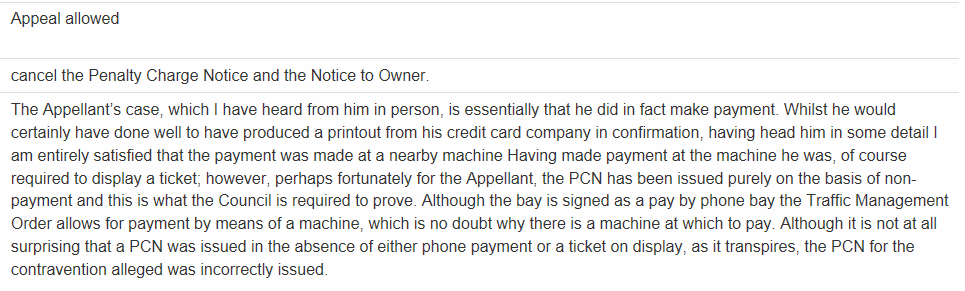
As you can see from the above extract of the tribunal register Barnet Council continue to ticket Royal Mail vans, make them do representations and write Appeals to the tribunal only to throw the towel in every time which wastes £30 of council tax each time = £270 just burnt. It also wastes the time of the fleet department at Royal Mail.

Extracts from other interesting tribunal cases, all allowed unless otherwise indicated:

Not on the zig zags (case 2170226373)

Do remember that another adjudicator is not bound by the above decision, it is not a precedent.

Zig zags not allowed across a junction (2170274875)

The school in question is St Joseph's RC Schools in St Joseph's Grove

Yellow box exit was clear on entry (2170279722)

Incontinence not a medical emergency (2170214680)

However harsh & unkind that may seem the decision is legally correct as the exemption in the Traffic Order will be for medical emergency.

Zig zags only apply to one side of the road (2170282159)

The question of what is the restricted area when it comes to school keep clear markings is one one which the courts have yet been asked to rule (unless you know otherwise). The sign refers to being 'on' the markings so if you are not on the markings I would argue you have not committed a contravention. Clearly though it would not be wise to stop in the middle of the road to allow children to board or alight.

Keep those Appeals coming.

Yours appealingly

Miss Feezance


Thursday, 21 September 2017

London Tribunals - June 17


A mobile dunny
In the month of June 2017 the adjudicators decided 182 Appeals in favour of the motorist i.e. their PCNs were cancelled. They refused 96 and asked the council to think again about 3 with a view to cancelling them. That is a win rate of 64%. That is not the full story though. Of the 281 Appeals which were started Barnet Council did not contest 129 of them so they became motorist wins by default. That is an amazing 46% of all Appeals that month. Whilst that may have been a one off due to staff holidays or some other reason it is still the case that Barnet Council rejected formal representations 129 times and then those motorists who persisted were rewarded with a cancellation. If everyone who had their formal representations rejected were to go to Appeal Barnet Council would implode.

There were 12 cases of particular interest and the adjudication decisions and case reference numbers are reproduced below:

6 minutes to PayByPhone - ok - 2170193070

The Appellant, whom I have heard in person in some detail, parked his vehicle in a pay by phone bay and immediately began the process of making payment by means of the app shown, as I accept, on the Council’s signage. Unfortunately there was a delay in finding a signal to enable the app to work successfully and by the time payment was made something of the order of six minutes had elapsed. During this time the vehicle was observed without any record of payment having been made and, unsurprisingly a PCN was issued.

On parking a vehicle a motorist is of necessity permitted a reasonable time to do whatever is necessary to validate the parking. Certainly the time in question will normally be fairly brief and the motorist must act promptly. In the present case six minutes is a fairly substantial time. However although on these facts the case is perhaps close to the borderline, it does seem to me that the time involved was not so long as to be unreasonable. The Appellant was, as I am satisfied, attempting to make payment throughout that time, and in the case of payment by means of an app in this way it is inevitable that minor delays of this type occasionally occur, Naturally the point will eventually be reached when the motorist has to accept that payment cannot be made promptly, and must then remove the vehicle or pay by some other means. However on the facts of this case I am not satisfied that point had quite been reached. It follows that, as it transpires, the vehicle was not in contravention and the PCN was incorrectly issued.

Representations wrongly rejected - 2170205690 (a council must not fetter the exercise of its discretion)

The Appellant said that he pulled over because his 4 year old daughter was in distress, apparently choking on water. He turned round in his seat to help her regulate her breathing.
The Authority's response in the Notice of Rejection was that there is no exemption that permits the Appellant to stop as no evidence has been produced to suggest it was a medical emergency.

The exception as stated in Schedule 7, Part 6, paragraph 4 (2)(b) in the Traffic Signs Regulations and General Directions 2016 applies to a vehicle "which is prevented from proceeding by circumstances beyond the driver’s control or which has to be stopped in order to avoid injury or damage to persons or property".

A medical emergency is likely to satisfy the above, but the exception goes beyond a medical emergency, and is applicable to the Appellant's case. The Authority is entitled to challenge the authenticity of the account, it is not entitled to reject the representations on the basis that the account cannot give rise to an exception.

There has been a procedural impropriety. I allow the appeal.

Delivering school meals to a school - 217017400A

I accept the Appellants’ evidence that the vehicle was there in order to deliver school meals. It is not entirely clear whether the delivery was to be made from that position or whether the driver was simply in the process of obtaining the key to gain access to an off-road delivery area. However whichever is the case there is no exemption in the Regulations (Schedule 7 Part 6 Traffic Signs Regulations and General Directions 2016) for loading/unloading, or for parking whilst gaining access to premises. The keep clear markings, in place for the safety of school children, are effectively a no-go area for motor vehicles, even vehicles having official business with the school in question. The vehicle was in contravention and the PCN was lawfully issued.

(No doubt if the Appellants were able to persuade the Council that there is no realistic alternative way to deliver this essential service some sort of formal dispensation would be granted, but in the absence of any such dispensation the vehicle cannot lawfully park there).

Unsigned PCN - not necessary - 2170225166

Mr. Halibard appeals on two bases, the first of which has two limbs. The first ground of appeal is that there was a procedural impropriety by the Enforcement Authority (EA) in that it a) implicitly misled him as to the effect of the Penalty Charge Notice (PCN) not having been signed by the Enforcement Officer (EO) and b) failed to have regard, in considering his representations following the issuance of the notice to owner (NTO), to evidence submitted by him after the service of the PCN but before the issuance of the NTO. The second, substantive ground of appeal is that the contravention did not occur because Mr. Halibard was at the relevant time engaged in loading of the vehicle in question, such as to bring him within the exemption (contained in Article 22(1)(h)) to the prohibitions imposed by the Council of the London Borough of Barnet Traffic Management Order 2015 (“the TMO”).

The EA’s case does not expressly address the first of the two procedural impropriety points raised by Mr. Halibard; the EA’s case, which is correct in law, as is accepted by Mr. Halibard, is that the PCN did not need to be signed. That is not quite the point that Mr. Halibard makes; he says the EA should not have asked him to provide the PCN in response to his representation on that point when, as they well knew, it would not have made a jot of difference. The EA also rather misses Mr. Halibard’s second point too. The EA’s case is that it does not accept the evidence, namely a letter from a grocery store from which Mr. Halibard says he was loading substantial quantities of fruit and vegetables. The EA is wrong to say that the letter was only provided at the appeal stage; Mr. Halibard’s e-mail of 13 February 2017 attaches it in his ‘representations’ prior to the issuance of the NTO. It was also provided again after his representations against the NTO were rejected. The EA’s case on the ‘loading’ issue is that they do not accept that sufficient evidence has been adduced to support Mr. Halibard’s case and that, in any event, the items were not sufficiently bulky or heavy that they could not reasonably be carried by hand.

Dealing with the first aspect of Mr. Halibard’s appeal, the EA should not have asked Mr. Halibard to provide the PCN when that was a document a copy of which was in its hands in any event and, further, when it knew that whether it was signed or not was immaterial. It should also, in my opinion, have had regard in evaluating Mr. Halibard’s representations to evidence which he had already submitted after he received the PCN but before the NTO was issued. The attached letter was probably received; the EA’s response of 20 February 2017 does not state ‘we did not receive your attachment’. The matter was perhaps complicated because on 22 February 2017 when he responded, Mr. Halibard did not re-attach the letter but a witness statement in an unrelated matter. In any event, Mr. Halibard did not re-send the letter in his formal representations against the NTO on 22 March 2017. I have to decide, however, whether there has been a procedural impropriety within the meaning of Regulation 4(5) of the Civil Enforcement of Parking Contraventions (England) Representations and Appeals Regulations 2007, as explained in London Borough of Camden v. Parking Adjudicator [2011] EWHC 295 (Admin). In my judgment, notwithstanding the above errors by the EA, there was no failure on its part to observe the requirements imposed upon it by the prevailing Regulations and the Traffic Management Act 2004. There was, therefore, no procedural impropriety within the meaning of regulation 4(5).

I do, however, uphold Mr. Halibard’s appeal on his second, substantive ground. I found his evidence to be credible and compelling. Mr. Halibard explained how he needed assistance from the shopkeeper to load the 4-5 heavy bags of fruit and vegetables he purchased for his family into the vehicle he then needed to drive them at least half a mile to his house. It would, I accept, be wholly impracticable to carry them home. He parked immediately adjacent to the shop for that purpose. The vehicle was only observed in that location for 2 minutes. The letter from Yarok grocery shop corroborates that evidence; although unfortunately undated it is signed. The EA’s point that there is no VAT number on the letter is misconceived; by virtue of Schedule 8 to the VAT Act 1994 there is no VAT payable on fruit and vegetables. Mr. Halibard falls within the exception in Article 22(1)(h) and the contravention did not occur. The appeal is therefore allowed. I would further observe that although the prohibition on parking outside the limits of bays may be on the EA’s website, it is not displayed at all on the sign at the relevant location.

Text sent = payment made - 2170232117

It is common ground that the Appellant attempted to pay by text. It is equally clear that, as it transpired, payment was not in fact made. The Council’s position is that unless and until payment is “confirmed” the motorist cannot assume that the payment has been made and accepted.

It seems to me that the onus is on the Council providing a pay by text system to explain to the motorist how the system works and what is required. I note the Council’s evidence of the instructions on the reverse of the timeplate “when paying by text etc...” However this seems to me to fall short of the clear warning necessary to the effect that until a confirmation text has been received payment has not been made – something that I do not regard as self-evident. It seems to me that the Appellant was entitled to assume that his payment had been made in the absence of any indication from the system to tell him otherwise. The Appeal is therefore allowed.

Saracens zone repeater signs - 2170233710

The Appellant said that she entered Engel park via Bittacy Rise. She accepts that there is signage indicating event day restrictions on Bittacy Rise but she had not thought that it would apply to another road.

The sign does say permit holders parking only past this point so the Appellant's understanding was incorrect. However, where there is a turn into another road after the sign, I would say that repeater signs are required.

I am not satisfied that the signage was adequate. I allow the appeal.

Suspension sign white not yellow - 2170233233

The Appellant was due to attend for a person or appeal before me this morning, but has not done so. No explanation has been received by the tribunal for the appellants absence. In the circumstances I consider it just and proportionate to determine her appeal on the information before me in the absence of the Appellant.

The Council's case is that the Appellant's vehicle was parked in a suspended bay in Cornwall Avenue on 15 December 2016. A penalty charge notice was issued at 1914.

The Appellant states that there was no signage on the side of the road where she parked. She adds that it was dark and that there was no sign of any works being carried out and that the period of suspension was unreasonable.

The Council rely upon the evidence of their civil enforcement officer. This includes a series of photographs of the vehicle and two of a close-up of a suspension sign. In answer to what appears to be a pre-populated question on his handheld device as to "distance to the nearest signing metres?", The answer is given as 4 m. I assume that this refers to the distance between the sign and the vehicle. The Council has also produced some location photographs, annotated with the position of the sign and the Appellant's vehicle.

I have considered the suspension sign and note that although there are no prescribed regulations as to the form or colour, it is white, as opposed to the more usual yellow suspension signs, that there is no "no parking" roundel on it, and that it is the same colour as the time plate on the post.

In all the circumstances I am not persuaded that the Council has established that the sign was adequate to convey the suspension to the motorist and therefore the appeal is allowed.

Kara Way - confusing signs - 2170212856

The Appellant, whom I have heard in person parked his vehicle on s single yellow line on a Sunday within what was a correctly signed Controlled Parking Zone. The Appellant saw the CPZ signs on entering the road and noted the operational hours; however he believed that those hours would not apply on a Sunday.

Had the case amounted to no more than this, the Appeal would inevitably have been refused. As the Council points out, if a sign is silent at to the days of operation the restriction applies on all days. However the Appellant examined the signs relating to adjacent designated parking places which gave the operational days as Monday to Sunday (i.e. every day of the week). On the basis of this he assumed that if the CPZ hours similarly operated Monday to Sundays (i.e. every day of the week) day the CPZ sign would have been similarly worded.

Having considered the matter carefully it seems to me that his assumption was a not unreasonable one. Motorists can reasonably expect there to be some consistency in signage within a small area. In my view this falls to be treated as one of those rare cases where the clarity of what is otherwise clear and correct signage is undermined by the presence of other ( equally correct ) signage. On the very particular facts of this case I am not satisfied that the signage was adequate to indicate to the Appellant sufficiently clearly that the yellow line operated on a Sunday; and it follows that , as it transpires, the PCN was incorrectly issued.

Cloned - council to prove their case - 2170150147

The issue in the case is whether the Appellant's was in contravention of restrictions.
The EA case is that the Appellant's vehicle was seen making a prohibited right turn, in contravention of restrictions, and so a PCN was issued to the vehicle.

The EA rely on contemporaneous footage.

The Appellant's case is that his vehicle registration plate having been cloned; he first became aware of this problem, when the Police telephoned him in respect of diesel not paid for at a petrol station, and the Appellant was provided with a Police reference number. He remarks that his vehicle is in fact petrol. He then received this PCN and another from EA's in areas that he has no need to travel.

The Appellant has submitted photographs of his vehicle, and has undertaken a "spot" the difference; which is as to the European mark on his plate, but not the photographs seen in the picture, and also a child's sticker in his vehicle which is not seen in the other vehicle.

I consider that the Appellant has provided a straightforward account of how he became aware of this, a Police reference number, photographs in support. The burden remains on the EA to show that the vehicle in contravention is the Appellant's vehicle; in the circumstances, in light of the points made, I am not satisfied that the EA have discharged this liability.

I therefore allow the appeal.

Alongside school entrance markings - 2170246585

The contravention alleged on the PCN is that this vehicle 'stopped in a restricted area outside a school . . . . .when prohibited'.

Signage at the location indicates that stopping is prohibited on entrance markings.

On the evidence before me the appellant's vehicle did not stop on such markings but to the side of them.

Upon that point being raised by the appellant although this prohibition on stopping applies to the whole of the length and breadth of the carriageway at this location that is not made clear on signage the prohibition as stated thereon applying to stopping on entrance markings only and I am not satisfied for that reason that this signage gives adequate indication of the ambit of the prohibition the council seeks to enforce.

The contravention has not accordingly I find been proved.

Greater than 50cm from kerb but passenger alighting - 2170250527

This PCN was issued for the alleged contravention of being parked in a special enforcement area more than 50cms from the edge of the carriageway and not within a designated parking place. The alleged contravention occurred in Hillview Gardens at 12.11am on 8 January 2017.

The alleged contravention arises by virtue of Section 85 of the Traffic Management Act 2004. Section 85(1) provides that, in a special enforcement area, a vehicle must not be parked on the carriageway in such a way that no part of the vehicle is within 50 cms of the edge of the carriageway.

Section 85(7) provides that "parking" for the purpose of this contravention does not include stopping to drop off or pick up a passenger where the vehicle is stopped for no longer than is necessary for that purpose.

I accept the evidence of Rabbi David that the car was stopped while he dropped off his 6 year old grandchild to 51 Hillview Gardens. There was only a one minute observation period before the issue of the PCN and it is, therefore, unsurprising that the CEO did not see the driver of the vehicle. The setting down exemption allows for a driver to leave the vehicle and to provide assistance to a passenger in reaching their destination where the passenger requires such assistance. I therefore find that the vehicle was not parked for the purposes of Section 85 and that the alleged contravention did not occur.

Disabled person needing the toilet - 2170252737

The appellant seeks to dispute liability for the charge on the ground that he is severely disabled he giving evidence as to his medical condition a consequence of which being that he frequently needs to use the toilet he on this occasion being 'caught short' he parking as he did because it was close to toilet facilities.

I acknowledge what is said but, on the assumption that I am being provided by the appellant with a truthful account of this incident, other than in the case of a medical emergency, which I am not persuaded on the appellant's case unsupported as it is by any medical evidence this was, there is no exemption that allows a motorist to park where restrictions are in force for the toilet to be used.

I note on the officer's photographs that a disabled badge and time clock were on display in the vehicle but the benefit of the disabled badge holder exemption may not be claimed where, as here, loading restrictions are in force.

I am satisfied against this background that the contravention occurred and am not satisfied that any exemption applies.


The appeal is refused.

Keep those Appeals coming. It is worth the effort.

Yours appealingly

Miss Feezance